
How Talat built a local-first stack for meeting notetaking
Into Talat's use of Core Audio and local LLMs to keep meeting data on-device.

I have used many meeting notetakers, including Otter, Fireflies, Granola, Plaud, Limitless (which is now a part of Meta), Krisp, Circleback, and Fathom. A lot of them started as a prosumer tool and then kept adding on features in the paid plan to suit teams and enterprises.
Plus, there is a question of retaining data and using it to plug into AI tools as well. Some tools might not allow that if you’re not on the business plan. One of the answers is Talat, an offline and private notetaking app that costs only $49 one-time purchase.
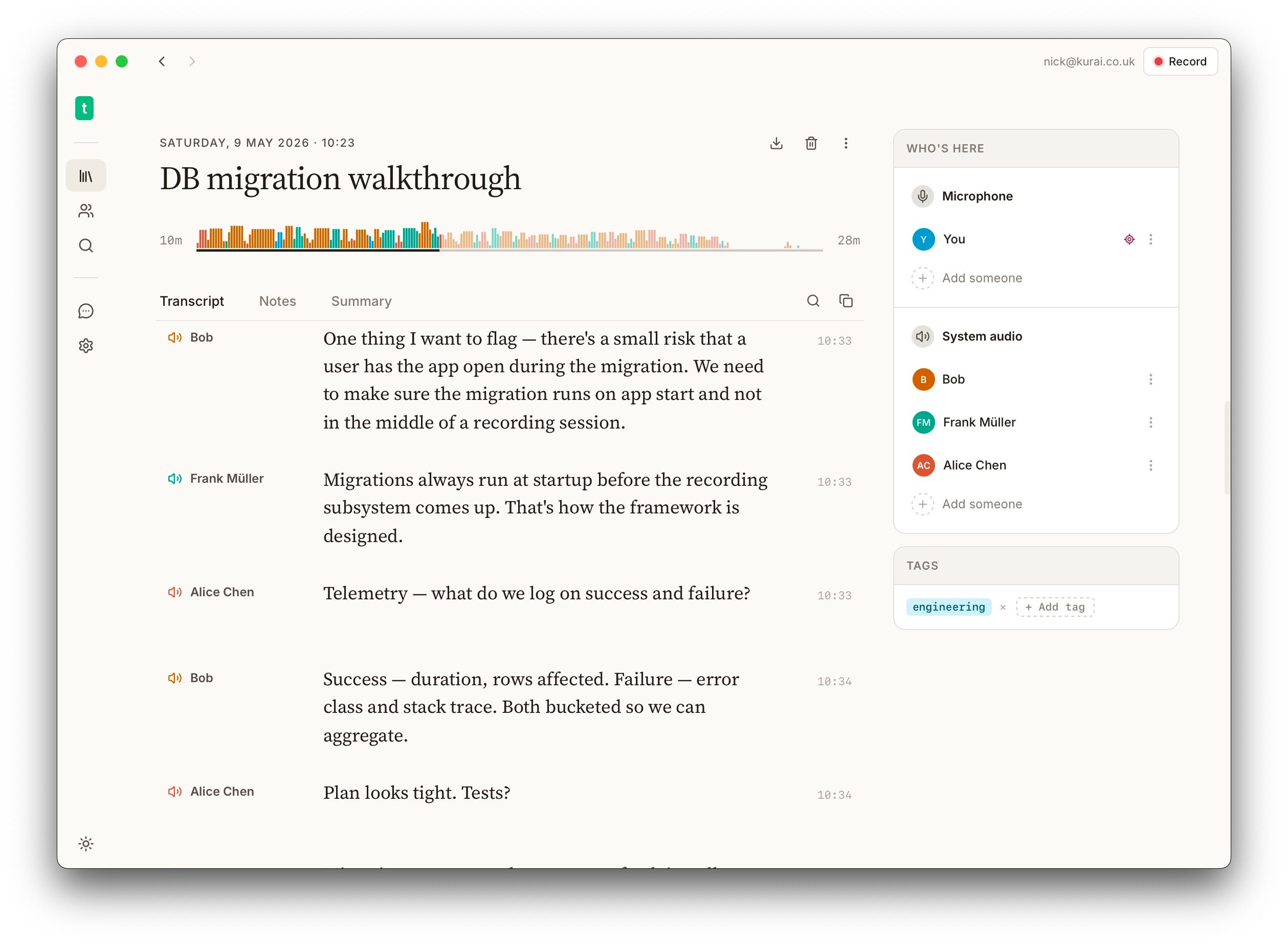
The app works on your system, both Mac and Windows, and uses system audio for transcription — just like Granola. It doesn’t require you to create an account, promises regular updates, and also allows you to record audio if needed. It shows you meeting transcripts and an AI summary once the meeting is over, and you can use text search to query meetings.
All models for transcribing and summarizing meetings are local LLMs, and you can choose to customize them. You can also change the prompt for summaries if you need to switch to another template.
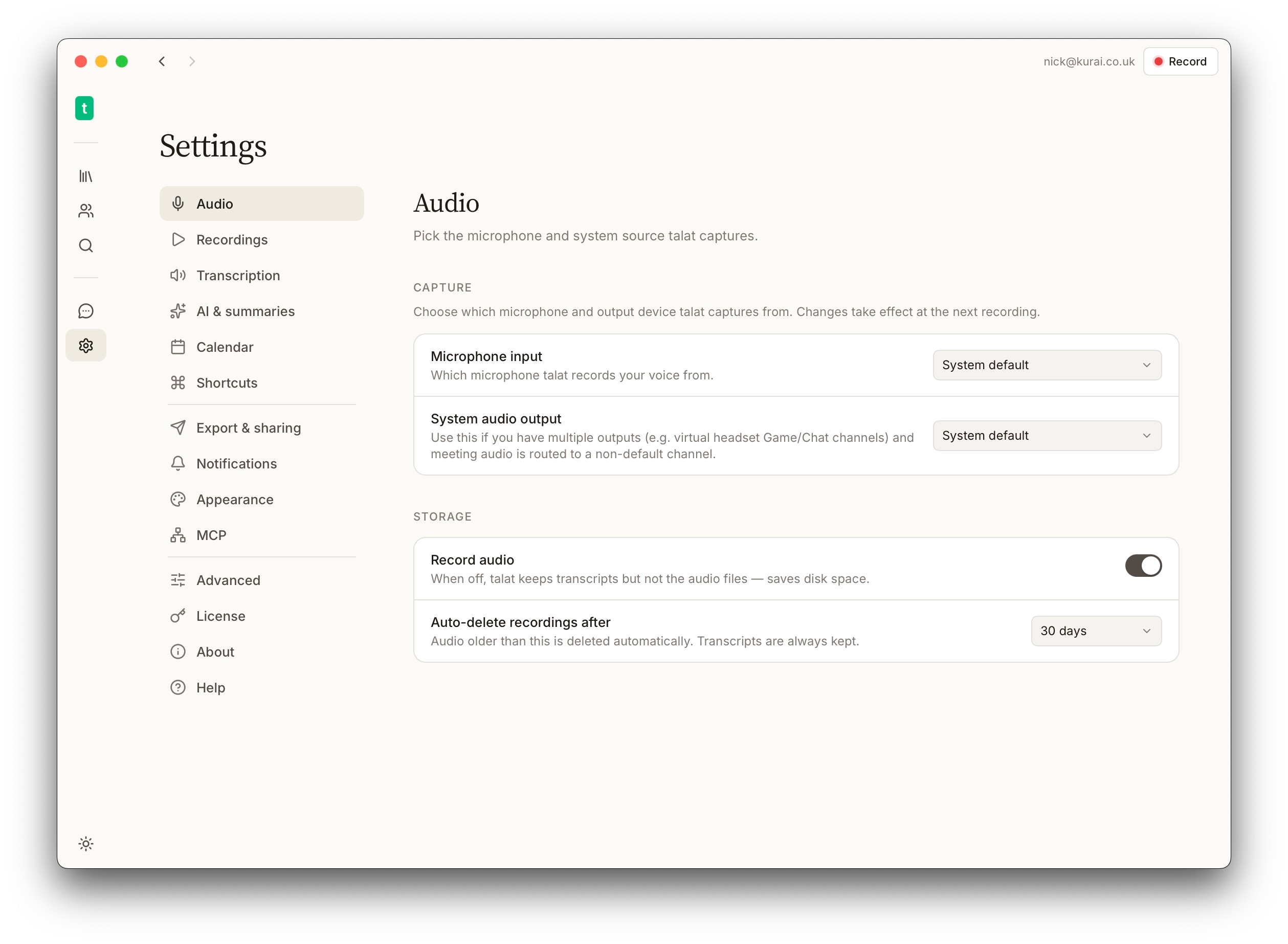
Last month, Granola locked local transcripts and the breaking AI agents. There was a lot of debate at the time around data ownership. Talat wants users to own their own data, and offers exports and MCP connectors to use in other AI tools.
Talat’s backstory
Talat is built by friends Nick Payne and Mike Franklin. Payne, who has spent a large part of his 20-year career in web development, said that when there were a lot of people on the call, and he had to lead the meeting, he felt anxious. A few years ago, someone introduced him to Granola, and he thought the app was great and allowed him to focus on meetings while taking notes.
Sometime ago, Granola started restricting people's free access to only 30 days of meeting transcript access. And this switch was sudden.
“I started getting pop-ups in the app saying, ’ You’re going to be downgraded, and you’ll lose anything more than 30 days of your meeting history. And as someone who’s run lots of SaaS tools in the past, I knew that they have to make money, but it’s so arbitrary that they are not letting me get my 30 days of meetings, especially because they’re cached on my machine. I can literally see them,” Payne said.
He also wanted control of his data and wanted to store everything locally, so he started building Talat.
I’m realizing, as we’re building Talat, that privacy and offline capability are huge features.
Technical stack
Payne was fascinated by Granola’s design and function and started digging into different voice models. He built a companion app, which helped prep for a meeting using voice. The tool also gave him tips during an ongoing conversation. But he felt that he couldn’t solve the latency problem to get instant answers.
While researching voice APIs and libraries, he came across Apple’s Core Audio Taps API, which could be used for system audio recording. Based on that, he built a more friendly abstraction layer called AudioTee, which makes it easier to use poorly documented Audio Taps.
He also used the Fluid Audio framework that lets you execute AI functions using CoreML. This enabled Payne to also do streaming transcription. This also allows for functions like speaker identification. Plus, the whole stack enables offline transcription through models like Nvidia’s Parakeet.
“I’m realizing, as we’re building Talat, that privacy and offline capability are huge features. Being able to have your meeting notetaker provide real-time transcription without an internet connection is a great unlock,” he said.
Payne understands that Talat won’t be able to cater to all kinds of workflows. With the app offering exports and MCPs, he said that he wants to design Talat in a way to “get out of your way” and let you build your own workflows.
In the past few months, a lot of open-source or one-time cost tools have cropped up, including OpenOats, Museli, and SamScribe. The idea is to let people who might not need a lot of features besides having transcription handy have control over their data.